
The Room Where It All Started

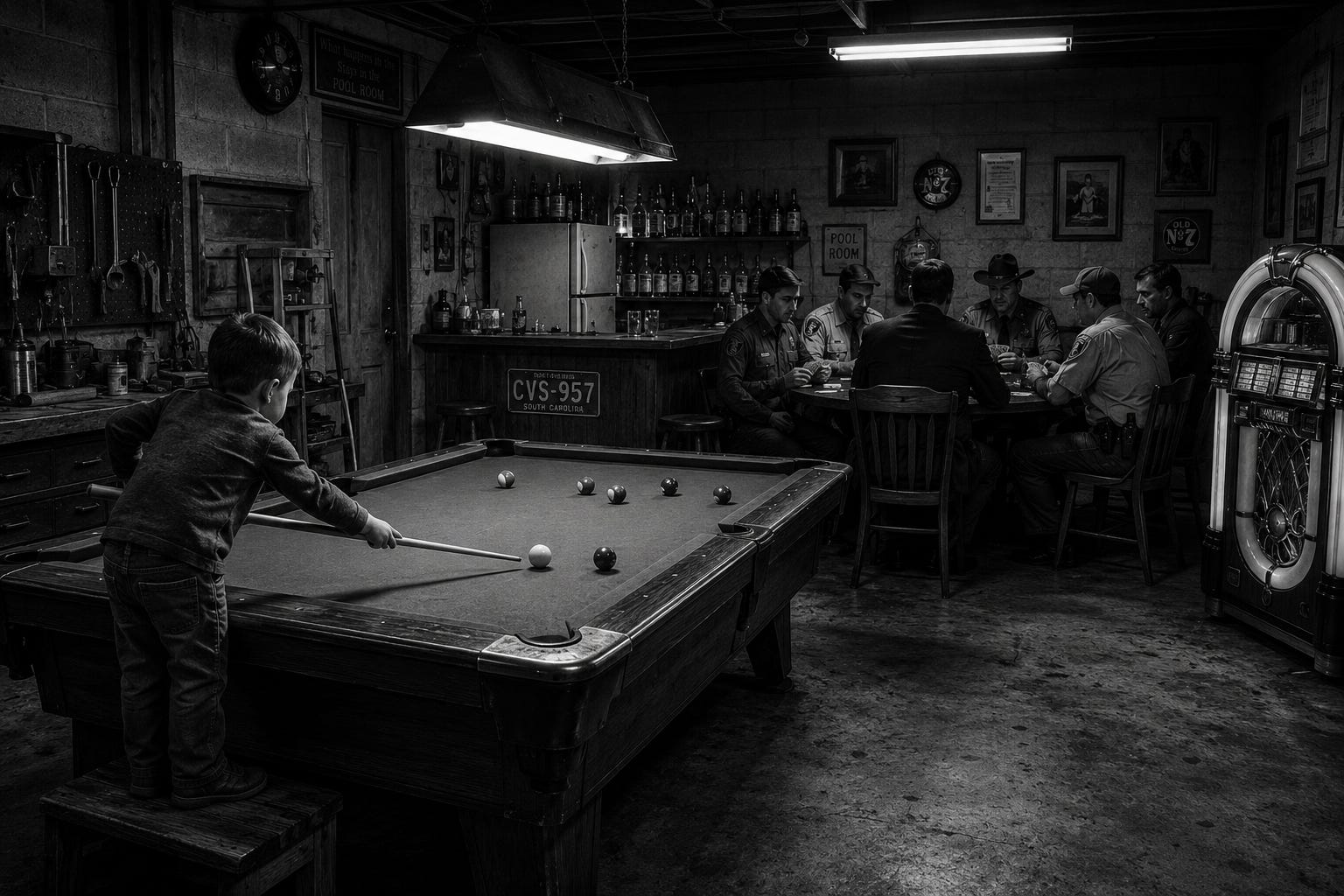
There was a building beside my father’s house that most people drove past without a second thought. Inside it, a three-year-old was learning things nobody intended to teach him.
The building was cinder block, no windows, a single door you had to know to look for, surrounded by a tall wooden privacy fence on the outskirts of Hartsville, South Carolina. From the road it looked like nothing. A storage structure, maybe, or a workshop, the kind of outbuilding that accumulates on properties in small southern towns and serves whatever purpose the owner needs it to serve on a given day. Most people drove past it without slowing down. I spent a significant portion of my childhood inside it, and what I absorbed there, without understanding that I was absorbing anything, shaped the next forty years of my life in ways I am only now able to describe accurately.
My father had built it or repurposed it over the years into something that served multiple functions. Against one wall, woodworking tools sat on a long bench, testament to projects started and sometimes finished. Against another wall ran a full-length oak bar with a refrigerator behind it and shelves holding whatever liquor anyone might need on a given evening. In the center of the room, taking up most of the open floor space, was the pool table. In the corner stood a jukebox, not the compact disc kind but the real kind, with actual 45s and LPs slotted behind the glass, the old-fashioned type that lit up amber and green when you plugged it in and made a mechanical clicking sound as it selected a record and set the needle down. My father had filled it with whatever moved him: Otis Redding, Percy Sledge, Fats Domino, Whitney Houston, Garth Brooks, Hank Williams Jr. It was a jukebox that refused to commit to a single decade or a single mood, and it was almost always running.
I had been in that building since I was old enough to follow my father through the door. By the time I was three years old, I was standing on a small wooden chair he had built so I could reach the rail of the pool table, gripping a cue stick he had cut down to my size, learning the geometry of a game I was too young to understand but that I could already feel the logic of. He taught me the way fathers of that generation taught things, not with patient instruction or careful explanation but by doing it himself and letting me watch and then handing me the cue and stepping back. Correction came in the form of a repositioned hand or a nudged elbow or a grunt of approval when I got something right. Not much was said. Not much needed to be.
In the years between three and five, that pool table was the center of my world. I shot alone while he worked at the bench twenty feet away. I shot while he drank with whoever had stopped by, the two of them talking about whatever men talk about on slow afternoons, largely ignoring me, which was fine. Being ignored in that room was different from being ignored in the house. In that room, being ignored meant I was present. It meant I was allowed to be there. That was enough.
WHAT THE ROOM WAS REALLY FOR
The building had a second function that only appeared on Wednesday nights and required the ordinary afternoon version of the space to be rearranged into something more deliberate.
My father held his weekly poker game in that room for years. The men who came were not strangers to anyone in Hartsville who paid attention to how a small southern town actually operated. Highway patrolmen arrived in their personal trucks with their uniforms half-undone. Sheriff’s deputies came straight from shifts, still carrying the alertness of men trained to watch rooms. City police officers sat elbow-to-elbow with attorneys who had faced them in hearings. Sitting judges showed up in civilian clothes that somehow still conveyed authority. State legislators came through the same wooden door as everyone else and became, inside that room, simply men with cards in their hands and drinks nearby.
The jukebox ran in the background. The refrigerator behind the bar stayed busy. Nobody was counting drinks or watching the clock. Alcohol was as natural a part of the evening as the cards themselves, and the cards were the most natural thing in the room.
I remember sitting in that room and looking around the table and feeling something I did not have a word for at the time. These were the men who enforced the law, who handed down sentences, who made the rules that everyone else in Hartsville was expected to follow. Here they were, drinks in hand, cards on the table, gambling on a weeknight like it was the most natural thing in the world. The logic that formed in a child watching all of this was not spoken and was not taught. It was absorbed. If these are the people who decide what is acceptable, then this must be acceptable. The logic was circular and entirely convincing and I carried it without examination for the next three decades.
WHAT A CHILD ABSORBS IN A ROOM LIKE THAT
I want to be precise about what I mean when I say I was learning things in that room nobody intended to teach me because the precision matters for understanding how this kind of formation actually works. Nobody sat me down and told me that gambling was normal. Nobody explained that alcohol was its natural companion or that the men who made the rules treated both of them as unremarkable features of ordinary life. Nobody intended to communicate any of that to a three-year-old standing on a wooden chair trying to reach the pool table.
The communication happened anyway. It happened the way the most durable learning always happens, not through instruction but through immersion, through the accumulated experience of being present in a space where certain things were simply the way things were. The pool table was just the pool table. The jukebox was just the jukebox. The poker game was just what happened on Wednesday nights. The drinks behind the bar were just what men had when they came by. None of it was presented as anything other than the ordinary furniture of the world, and the child in the room received it as exactly that, the ordinary furniture of the world, the baseline against which everything else would eventually be measured.
That baseline is the thing I have spent the most time examining in the past two years because it is the thing that explains more about what happened later than any other single factor I can identify. Not the addiction itself, which developed through its own sequence of decisions and escalations and had its own arc separate from any single cause. The baseline. The specific understanding of what was normal that formed in a child who spent his earliest years in a room where powerful men gambled and drank without any apparent awareness that either activity required justification.
By the time I was fifteen, I was sitting at the poker table myself, old enough to be included, holding my own against the men who had populated that room my entire childhood. By that same age, I was shooting pool for cash in bars and pool halls where nobody asked how old I was because in Hartsville, if you could shoot, you were welcome at the table. I was placing sports bets with the local bookie. None of this felt like the beginning of anything because none of it felt like anything other than the continuation of the world I had always known.
That is the specific cost of the early formation. Not that it creates addicts inevitably or mechanically from children who are exposed to it, because that is not how causation works in human development and I am not going to overclaim it. The cost is that it removes the alarm. The warning system that would signal to an ordinary person that the behavior they are engaging in is unusual, potentially dangerous, worth examining before it becomes a pattern, that system was calibrated in that cinder block building to treat these behaviors as entirely unremarkable features of adult life. By the time the behaviors produced consequences large enough to register as problems, the baseline had been set for decades and the recalibration required to see them clearly was an enormous amount of work that I was not, for a very long time, willing to do.
THE JUKEBOX IS STILL THERE
The block building is still there. I drove past it recently. Cinder block walls, same door, same nothing from the outside. The room is still inside me in the way that the first rooms always are, the ones where we learned the most basic things about how the world works before we had the language or the distance to examine what we were learning. The jukebox songs are in my nervous system. Forty years later, a particular Otis Redding opening or a specific chord change in a Percy Sledge song will stop me wherever I am and return me to that room with the concrete floor and the smell of cigarette smoke and cold beer and wood shavings and the sound of pool balls breaking and cards slapping felt.
The room taught me something that took forty years to unlearn. That gambling was ordinary. That alcohol was its natural companion. That belonging looked like a specific combination of a game and a bet and powerful men who treated both of them like furniture.
The unlearning is the work I am doing now. It is slow work and it is incomplete and it will probably always be incomplete in some measure because the things we absorb before we have language for them do not simply disappear when we find the language. They become part of the structure, and changing the structure requires understanding it first, which requires looking clearly at the room where the structure was built and naming honestly what was taught there.
I wrote this for anyone who grew up in a room that was teaching them things nobody intended to teach them. The room does not have to be a cinder block building in South Carolina. It can be any space where the adults around you treated something dangerous as unremarkable, and where you absorbed that treatment as the baseline against which everything that came later would be measured.
If you recognize that room, subscribe below. I am going to keep writing about what it takes to see it clearly and what the seeing produces.
Damn, that's such a solid observation. I'm one of the many people who've never personally faced addiction but dealt with it in friends and family, and I do a lot of work in the recovery realm. Awareness of these things that "normalize" behavior seems like something we need much more of. Also, google up the poem by Louise Gluck, "The Wild Iris" - I've never read anything that so beautifully captures what happens when one emerges from trauma or addiction. She won the Pulitzer for that collection, but I suspect she won it for the last lines of that poem, about "returning from oblivion". Your voice in these articles reminds me of that.